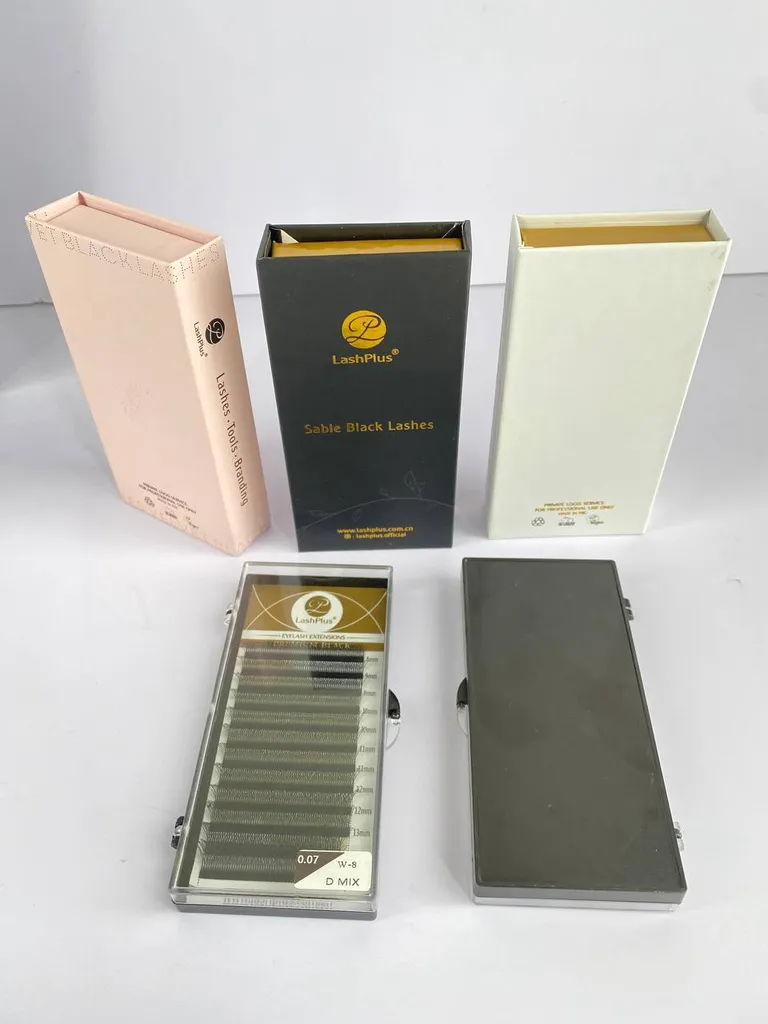
Buyer’s guide
The Lash Brand’s Buyer’s Guide to Custom Eyelash Packaging (2026)
Written by our team — 20+ years in beauty export and lash OEM production, working with lash brands, academies, and private-label sellers shipping worldwide.
Quick answer
For most lash brands, the right starting box is a matte-laminated tuck-end or drawer-style folding carton in 300–350gsm coated paperboard, with foil or spot UV on the logo, a simple paperboard insert, and an MOQ of 100 units. Upgrade to magnetic rigid boxes once you have proven sell-through and want a premium unboxing moment, or a PVC-window carton if buyers need to see the lashes before they buy. Whatever structure you choose, confirm upfront that there is no hidden die-cutting or plate charge — that single line item is where most first-time buyers get overcharged.
Who this guide is for
This guide is written for:
- Lash brand founders launching or refreshing a retail line and ordering packaging for the first time
- Lash artists and academies who want branded boxes for kits, student sets, or salon retail
- Beauty e-commerce sellers private-labelling lashes, fans, or clusters for Amazon, TikTok Shop, or their own site
- OEM/private-label buyers comparing structures, materials, and finishes before requesting quotes
If you already know your structure and just need specs, jump to the Compare at a glance table or the Pre-order checklist. If you’re starting from zero, read straight through — every section builds on the last.
Pick your box by sales channel
Your sales channel decides your box more than your brand aesthetic does. Match to your primary channel first, then style it.
| Sales channel | Best-fit structure |
|---|---|
| Retail shelf / boutique | Tuck-end carton with strong front-facing branding, or magnetic rigid for premium shelf presence |
| Online-only (DTC, Amazon, TikTok Shop) | Drawer/sleeve or tuck-end carton — unboxing video appeal matters more than shelf-facing |
| Salon handoff / in-treatment sale | Simple tuck-end carton or clamshell — fast, low-cost, protects product during a same-day sale |
| Gifting / bundles / kits | Magnetic rigid box or drawer box with a foam or molded pulp insert for a multi-item layout |
If you sell across two or more of these channels, don’t force one box to do every job — most brands run a low-cost tuck-end carton for salon/wholesale and a magnetic rigid box for their hero online SKU.
Compare at a glance
| Structure | Best for | Unboxing feel | Relative cost |
|---|---|---|---|
| Tuck-end folding carton | Wholesale, salon, high-volume retail | Clean, functional, fast to open | Lowest |
| Drawer / sleeve box | E-commerce, mid-tier retail | Satisfying slide-out reveal | Low–mid |
| Magnetic rigid box | Flagship SKUs, gifting, premium retail | Heavyweight, luxury “snap” close | Mid–high |
| PVC-window carton | Product-led selling, in-store trial | Transparent, builds trust pre-purchase | Low–mid |
| Clamshell / PET | Single-use, kits, salon takeaway | Utilitarian, see-through, fast pack | Lowest |
Structures explained
Tuck-end folding carton
The workhorse of lash packaging. A single flat-pack die-cut that folds and tucks shut without glue in most designs, or with a simple auto-lock bottom for extra strength. Ships flat, assembles fast, and prints beautifully on coated stock.
Pro tip: specify an auto-lock (crash-lock) bottom rather than a basic tuck-in base if the box will be handled a lot in-store — it survives repeated opening far better.
Drawer / sleeve box
A rigid or semi-rigid inner tray that slides inside an outer sleeve. Slower to unbox, which is exactly the point for e-commerce brands chasing “unboxing experience” content.
Pro tip: leave 1–2mm of drawer play in the die design — too tight and the drawer sticks after transit humidity swings; too loose and it rattles.
Magnetic rigid box
Wrapped rigid greyboard with an embedded magnetic closure. This is the structure that makes a modest lash set feel like a premium product. Higher cost per unit, but the highest perceived value.
Pro tip: magnetic closures add real cost at low volumes — a ribbon-pull or friction-lid rigid box gets you most of the premium feel for meaningfully less.
PVC-window carton
A standard folding carton with a die-cut window backed by clear PVC or PET film, letting the buyer see the lashes, curl, or fan set before purchase.
Pro tip: position the window over your strongest visual feature (the curl, the fan, the length) — not just centred for symmetry. The window should sell the product, not decorate the box.
Clamshell / PET
A fully transparent, hinged or two-piece plastic pack. Cheapest per-unit structure, minimal branding surface, but fast to produce and effective for kits or salon takeaway where the box isn’t the marketing tool.
Pro tip: if you need brand presence on a clamshell, a printed paperboard header card or backer sheet does more work than trying to print directly on the plastic.
Materials
SBS / coated paperboard (250–350gsm)
The default material for folding cartons. SBS (solid bleached sulphate) board takes print and foil cleanly and holds a crease well at this weight range.
Pro tip: 250gsm is fine for small single-unit boxes; step up to 300–350gsm for anything holding multiple items or shipping loose in a mailer without an outer carton.
Rigid greyboard
Thick, dense board (typically 1.5–2mm) wrapped in printed paper. This is what gives magnetic and drawer boxes their weight and “premium” feel — the board itself, not the print, is what buyers physically feel first.
Pro tip: thicker isn’t always better past 2mm — it adds shipping weight and cost without a proportional lift in perceived quality. 1.5–2mm is the sweet spot for most lash SKUs.
PET / PVC window film
Clear film laminated or glued behind a die-cut window. PET is the more common export-compliant choice for buyers who want to avoid PVC specifically; both are workable and your factory should offer either.
Pro tip: ask for the window film to be tucked and glued, not just taped — taped windows are the single most common QC fail we see on incoming samples.
Finishes
Matte lamination
A soft, non-reflective film laminate over the printed board. The most common lash packaging finish because it photographs well and resists fingerprints.
Pro tip: matte shows scuffs less than gloss but shows dents more — good for retail handling, less forgiving in bulk transit if your outer carton padding is thin.
Gloss lamination
Reflective, vibrant, cheaper than matte in most cases. Reads as “mass retail” rather than “premium” unless paired with strong foil contrast.
Pro tip: gloss is the right call for bold, colour-saturated brand art — it makes photography and colour pop in a way matte flattens.
Soft-touch lamination
A velvet-like coating with a distinct tactile “give.” Strongest perceived-premium finish available on a folding carton, at a real cost step up from matte.
Pro tip: soft-touch marks easily from oily fingers and shows fingerprints — pair it with spot UV on the logo so the touch-point area is protected and glossy against the matte-soft field.
Foil (hot stamp)
Metallic or pigment foil stamped onto logo, wordmark, or accent details. The fastest way to signal premium without changing the whole print run.
Pro tip: foil dies are typically included with no extra plate charge in a properly quoted factory-direct run — confirm this before you sign off, as it’s a common upsell trap elsewhere.
Spot UV
A glossy raised coating applied only to selected areas, usually over matte or soft-touch stock, for contrast and texture.
Pro tip: spot UV needs decent contrast to read well in photos — test it on your actual logo shape before committing, as fine text under a certain point size can blur under UV coating.
Emboss / deboss
Raised (emboss) or pressed-in (deboss) texture, usually combined with foil for a “foil-emboss” combo look.
Pro tip: emboss/deboss needs a dedicated metal die separate from the cutting die — factor this into lead time, not cost, since it’s a production step, not a hidden fee.
Inserts
- Paperboard cradle — die-cut card insert that holds the lash tray or box in place. Cheapest, fully recyclable, standard for most SKUs.
- EVA/foam insert — cut-to-shape foam for kits with multiple items (tools, lashes, adhesive). Adds protection for fragile or multi-part sets.
- Molded pulp insert — recycled fibre pressed into shape, a middle ground between paperboard and foam on sustainability messaging and cost.
- PET tray insert — clear rigid tray, often used with window cartons so the product sits visibly in place rather than loose against the window.
What drives your cost
| Cost driver | Impact |
|---|---|
| Structure complexity | Rigid and magnetic boxes cost more per unit than folding cartons at the same volume |
| Board weight / thickness | Heavier stock and thicker greyboard raise material and freight cost |
| Print colours & coverage | Full-colour, edge-to-edge print costs more than spot colour on a white or kraft base |
| Finish combinations | Stacking foil + spot UV + soft-touch compounds cost more than any single finish alone |
| Order volume | Per-unit cost drops meaningfully as volume scales past MOQ — the single biggest lever |
| Insert type | Foam and molded pulp cost more than a simple paperboard cradle |
| Window / PVC-PET elements | Adds a material and an assembly step versus a solid carton |
| Turnaround speed | Rushed production timelines typically carry a cost premium over standard lead time |
Note what’s not in this table: die-cutting and printing plates. On a properly structured factory-direct quote, these are a one-time setup cost disclosed upfront, not a recurring hidden charge on every reorder.
The 3-tier framework
Tier 1 — Starter. Tuck-end folding carton, 250–300gsm SBS board, matte lamination, single-colour foil logo, paperboard cradle insert. Built for brands testing a new SKU or ordering their first branded run at MOQ.
Tier 2 — Growth. Drawer/sleeve or tuck-end carton, 300–350gsm board, matte or soft-touch lamination, foil plus spot UV combo, paperboard or light foam insert. For brands with proven sell-through ready to invest in shelf and unboxing differentiation.
Tier 3 — Premium. Magnetic rigid box, 1.5–2mm greyboard, soft-touch lamination, foil-emboss combo, foam or molded pulp insert. For flagship SKUs, gifting lines, influencer sends, and brands positioning at the top of their category.
Most brands should start at Tier 1 or Tier 2 — not because premium doesn’t sell, but because MOQ 100 lets you test cheap and reorder into Tier 3 once a SKU proves itself, rather than committing rigid-box budget to an unproven product.
From artwork to delivery
- Brief and structure selection — confirm sales channel, structure, dimensions, and target quantity.
- Free dieline provided — you receive a to-scale template to design or brief your designer against, at no charge.
- Design support — if you don’t have a designer, ask for help laying out your artwork onto the dieline; typically offered free as part of the quote process.
- Digital proof (PDF) — a flattened, colour-accurate proof for sign-off before anything is produced physically.
- Physical sample on request — a real, printed sample of your actual box, so you can check colour, board weight, and finish in hand before committing to a bulk run.
- Bulk production — once samples are approved, the full run goes into production against the same specs and files.
- Pre-shipment QC — bulk stock is checked against the approved sample before it ships.
- Delivery — shipped factory-direct, with lead time confirmed at order placement, not estimated after the fact.
Need the lashes too? We’re a lash OEM factory — ask about combined packaging + product runs, so your boxes and your lashes arrive from a single coordinated production timeline instead of two separate suppliers working on two separate schedules.
Stress test your box
Before you commit to a bulk order, physically test your sample the way transit and retail will test it:
- Drop test — drop the closed, filled box from waist height onto a hard floor, several times, on different edges. It should hold its shape and closure.
- Compression test — stack several sample boxes and apply weight on top for a few hours, simulating a shipping carton. Check for crushing or seam separation.
- Humidity check — leave a sample in a bathroom or humid room overnight. Watch for warping board, lifting lamination, or a sticking drawer/window.
- Repeated open-close — open and close the box 15–20 times. Tuck-ends and magnetic closures should still hold tension; drawers should still slide cleanly.
- In-transit simulation — if possible, ship a sample box to yourself via your actual courier before locking the bulk order.
A box that fails any of these on a sample will fail at scale — cheaper to find out now than after thousands of units are in a warehouse.
Quality control
On samples, check:
- Colour match against your submitted Pantone or CMYK values
- Board weight and rigidity match spec (not just “looks about right”)
- Foil/UV/emboss registration — is it sitting exactly on the artwork, not shifted
- Closure mechanism (tuck, magnet, drawer fit) opens and closes cleanly
- Insert fits the product without excess movement or forced pressure
On bulk stock, check (or request the factory’s pre-shipment report for):
- A pulled sample count against the approved reference sample, not just the first unit off the line
- Consistent print colour across the full run, not just the first batch
- Carton packing — units correctly boxed for transit, not loose-packed
- Any visible damage from production and packing before it leaves the factory
Common mistakes & fixes
- Choosing rigid magnetic boxes for a first-ever order with no sales data. Fix: start Tier 1 or Tier 2 at MOQ 100, prove the SKU, then upgrade the reorder.
- Not asking about die and plate charges until after the quote is signed. Fix: ask explicitly upfront — factory-direct MOQ 100 orders should not carry a hidden setup fee buried in a later invoice.
- Designing artwork without the dieline, then forcing it to fit. Fix: request the free dieline first, design onto it, not the other way round.
- Skipping the physical sample and approving from a digital proof alone. Fix: always get a physical sample — screen colour and printed colour are never identical.
- Choosing a finish combo (soft-touch + foil + spot UV + emboss) without budget context. Fix: pick one or two finishes that support your brand’s actual price point, not every finish available.
- Ignoring humidity and transit conditions for your specific shipping route. Fix: run the stress tests above before locking bulk production, especially for long-distance or high-humidity lanes.
- Ordering a window carton without checking the window seals cleanly. Fix: confirm tucked-and-glued window construction, not taped, at sample stage.
- Treating packaging and product as two unrelated supply chains. Fix: if you’re also sourcing lashes, ask about combined packaging + product production to align timelines.
Pre-order checklist
- Sales channel and structure confirmed (see the channel-mapping table)
- Board weight and material specified (250–350gsm coated board or greyboard thickness)
- Finish(es) chosen and budget-appropriate for your price point
- Insert type selected and fitted to your actual product dimensions
- Free dieline requested and artwork designed to spec
- Digital proof reviewed and signed off
- Physical sample ordered and stress-tested (drop, compression, humidity, open-close)
- MOQ and pricing confirmed with no hidden die/plate charge
- Lead time confirmed in writing, including bulk production and shipping
- Cross-sell checked — do you need lashes sourced too, on the same timeline?
Key points
- Match structure to sales channel first — tuck-end for wholesale/salon, drawer for e-commerce, magnetic rigid for flagship/gifting, window carton for product-led selling.
- MOQ 100 means you can start small and reorder into a premium tier once a SKU proves itself — don’t overcommit to rigid boxes on unproven products.
- There should be no hidden die-cutting or plate charge on a properly quoted factory-direct order — ask upfront, every time.
- Free dieline, free design help, and samples on request should be standard parts of the process, not paid extras.
- Always stress-test a physical sample (drop, compression, humidity, repeated open-close) before committing to bulk.
- QC applies at both sample stage and bulk stage — don’t approve from digital proofs alone.
- If you’re also sourcing lashes, combining packaging and product production with one OEM partner cuts coordination time.
FAQ
What’s the minimum order quantity (MOQ) for custom lash packaging? 100 units is a standard starting MOQ for factory-direct custom lash packaging, covering most structures including tuck-end cartons, drawer boxes, and window cartons.
Are there hidden die-cutting or plate charges? On a properly structured factory-direct quote, no. Die-cutting and plate setup should be disclosed as a one-time cost upfront, not added later or repeated on every reorder of the same design.
Can I get a free sample before ordering in bulk? Physical samples are available on request before you commit to a bulk run — always confirm your colour, board weight, and finish against a real sample, not just a digital proof.
How long does production and delivery take? Lead time depends on structure, finish complexity, and order volume, and should be confirmed at order placement — ask for this in writing before you commit, not as a rough estimate after.
What artwork format do I need to send? A print-ready vector file (typically AI, EPS, or high-resolution layered PDF) built onto the dieline provided, with fonts outlined and colours specified in Pantone or CMYK.
Do you also supply the lashes, not just packaging? Yes — we’re a lash OEM factory as well as a packaging producer. Ask about combined packaging + product runs if you need both sourced and coordinated on one timeline.
Are there eco-friendly or recyclable packaging options? Paperboard structures (tuck-end cartons, drawer boxes) are generally recyclable, and molded pulp inserts are a fibre-based alternative to foam. Materials are export-compliant and REACH-aware; specific eco claims should be confirmed against your target market’s labelling requirements.
Can I reorder in smaller batches after my first bulk run? Yes — once your dieline and artwork are set up, reorders typically don’t require redesign, and small-batch reorders are usually more efficient to produce than the first run.
Do you offer design help if I don’t have a designer? Yes — layout support onto the provided dieline is typically included as part of the quote process, so you don’t need an in-house designer to get to a print-ready file.
References
- ASTM D4169 transit and distribution testing (general packaging industry standard)
- ISTA package testing procedures (general industry practice for shipping durability)
- GSM (grams per square metre) as the standard international measure for paperboard weight
- Pantone Matching System (PMS) as the standard reference for spot-colour print accuracy
- FEFCO/ECMA folding carton style codes (general reference for structural carton styles)